
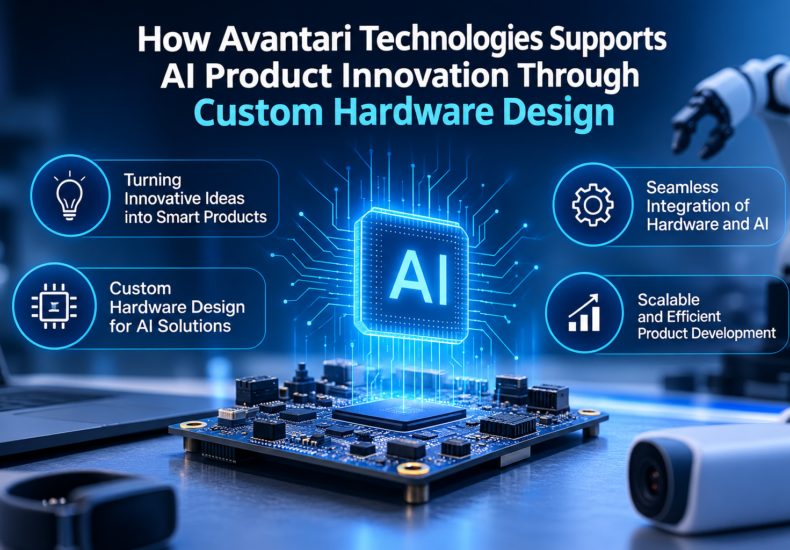
How Avantari Technologies Supports AI Product Innovation Through Custom Hardware Design?
Artificial intelligence is transforming the way businesses develop products, automate processes, and deliver intelligent user experiences. From connected consumer electronics to industrial automation systems, AI-powered devices are becoming increasingly important across industries. However, building a successful AI product requires more than developing sophisticated software. It also involves selecting the right processors, designing efficient electronic circuits, integrating sensors, optimizing power consumption, and ensuring that all hardware components work together seamlessly.
This is where a Custom AI Hardware Design Agency plays an important role. By combining electronic engineering, embedded systems development, hardware architecture, and AI integration, specialized engineering teams help businesses transform innovative concepts into practical, reliable products. Avantari Technologies supports this product development approach by focusing on hardware engineering and intelligent technology solutions that help businesses move from initial concepts toward functional products.
Understanding the Importance of Custom AI Hardware Design
AI applications often have specific computational and operational requirements that conventional hardware may not adequately address. A device designed for real-time object detection, for example, may require different processing capabilities, memory resources, sensor configurations, and thermal management solutions than a smart home device that performs basic voice recognition.
Custom AI hardware design focuses on developing hardware architectures that match the intended application. Instead of relying entirely on generic components or standard development platforms, businesses can select and integrate components according to their performance, cost, size, connectivity, and energy requirements.
A well-designed AI hardware solution can improve processing efficiency, reduce unnecessary power consumption, and support more responsive device operation. It can also help businesses create differentiated products that offer capabilities tailored to their target markets.
Avantari Technologies operates in the product engineering space, where hardware development and technology integration are important considerations for companies building innovative electronic products. A structured engineering approach helps businesses evaluate technical requirements and make informed decisions throughout the development process.
How a Custom AI Hardware Design Agency Supports Product Innovation
Developing an AI-powered product involves several interconnected engineering activities. Working with a specialized development partner can help businesses address these requirements systematically.
1. Converting Ideas into Practical Hardware Architectures
Many product innovations begin with a business problem rather than a detailed technical specification. A startup may want to develop an intelligent monitoring device, while an established company may be exploring automation through AI-enabled electronics.
The first challenge is translating these ideas into a workable hardware architecture.
This process generally involves defining the product’s intended functions, identifying processing requirements, evaluating input and output interfaces, and selecting suitable electronic components. Engineers must also consider the operating environment, expected product lifespan, manufacturing constraints, and anticipated production volumes.
For example, a portable AI-powered device may require a compact processor, low-power sensors, wireless connectivity, and an efficient battery management system. An industrial AI system may prioritize reliable operation, support for multiple sensors, and the ability to process data under demanding environmental conditions.
A Custom AI Hardware Design Agency helps businesses evaluate these factors before committing to a particular design direction. Early technical planning can reduce avoidable redesigns and provide a stronger foundation for subsequent development stages.
2. Selecting the Right Processing Platform
The processing platform is one of the most important decisions in AI hardware development. Different applications require different balances of computational performance, energy efficiency, cost, and physical size.
Depending on the use case, engineers may consider microcontrollers, application processors, graphics processing units, neural processing units, field programmable gate arrays, or dedicated AI accelerators.
Microcontrollers can be appropriate for lightweight inference and sensor-based applications. More computationally intensive applications, such as advanced computer vision, may require processors capable of handling larger neural networks and complex data streams.
The choice also depends on whether AI inference will take place directly on the device, in a nearby edge computing system, or through cloud infrastructure.
Edge AI can reduce dependence on continuous internet connectivity and may improve response times for applications that need immediate decisions. However, it also places greater demands on local processing resources, memory, thermal management, and power consumption.
By evaluating these technical trade-offs, engineering teams can help businesses select hardware that aligns with their product objectives rather than choosing components based solely on specifications.
3. Integrating AI with Embedded Systems
AI software must operate within the practical limitations of the hardware that supports it. This makes embedded systems development an essential part of many intelligent product engineering projects.
Embedded systems combine processors, firmware, sensors, communication interfaces, and application-specific electronics to perform defined functions. When AI is introduced, these components must work together efficiently.
For instance, a smart inspection device might collect images through a camera, process them using an embedded AI model, and communicate the results to another system. The hardware must support image acquisition, data movement, model execution, and communication without introducing unacceptable delays.
Engineers must also consider memory availability, processor utilization, firmware architecture, and compatibility between software frameworks and hardware platforms.
Avantari Technologies can be considered within this broader product engineering landscape, where hardware and embedded technology are central to turning product concepts into functional systems. For businesses evaluating development partners, the important consideration is whether the selected team can address the specific integration requirements of the intended AI application.
4. Designing Custom Printed Circuit Boards
Printed circuit board design is another critical element of AI product development. The PCB provides the electrical and physical foundation that connects processors, memory, sensors, power management components, and communication modules.
AI-enabled products can introduce additional PCB design challenges because high-speed processing, wireless communication, power delivery, and thermal performance may all affect the overall design.
A carefully engineered PCB can help maintain signal integrity, manage electromagnetic interference, distribute power effectively, and support reliable operation. Component placement and routing decisions can also influence the final product’s dimensions and manufacturing cost.
For compact devices, the challenge becomes even more significant. Engineers must fit the required functionality into limited space without compromising electrical performance or serviceability.
A Custom AI Hardware Design Agency can support this process by evaluating circuit requirements, developing PCB layouts, reviewing component compatibility, and preparing designs for prototype fabrication.
The objective is not simply to create a circuit board that functions under ideal conditions. It is to develop a design that can be tested, refined, manufactured, and integrated into the final product.
5. Building and Testing Functional Prototypes
Prototyping allows businesses to validate their ideas before investing in large-scale production. It provides an opportunity to evaluate hardware functionality, identify integration issues, and compare actual performance with the original product requirements.
During AI hardware prototyping, engineers may assess processing speed, inference latency, sensor accuracy, power consumption, wireless performance, and operating temperature.
Testing can also reveal practical issues that are difficult to identify through theoretical analysis alone. A processor may perform well in a laboratory environment but require additional thermal management when installed inside a compact enclosure. Similarly, a wireless module may experience interference when positioned near other electronic components.
Prototype testing helps identify these issues early, when design modifications are generally easier to implement.
Businesses can use the results to refine component selection, optimize PCB layouts, improve firmware, and adjust mechanical configurations. Repeated testing and refinement create a more reliable path from an initial concept to a production-ready design.
The Role of Custom AI Hardware in Edge Computing and IoT
The growing adoption of connected devices has increased the importance of efficient AI hardware. Internet of Things applications generate data through sensors, cameras, meters, and other connected components. AI can analyze this information to identify patterns, recognize events, and support automated decisions.
However, transmitting every data point to a remote server can introduce latency, increase connectivity costs, and create additional privacy considerations.
Edge AI addresses these challenges by enabling devices to process selected data locally. For example, an intelligent industrial sensor may identify an unusual operating pattern without continuously transmitting raw measurements to the cloud.
Similarly, a smart camera can perform preliminary image analysis locally and transmit only relevant events or results.
Custom hardware design helps businesses optimize these applications according to their particular needs. Engineers can select suitable processors, design sensor interfaces, integrate communication modules, and evaluate power requirements for continuous operation.
A Custom AI Hardware Design Agency can also help determine which tasks should run locally and which are better handled by cloud-based services. This balance can improve system efficiency while preserving flexibility for future software updates and expanded functionality.
For businesses developing connected products, the combination of embedded systems, AI processing, and reliable communication is an important consideration from the earliest design stages.
Why Startups Benefit from Specialized AI Hardware Engineering
Startups often face significant constraints when developing hardware-based AI products. Limited budgets, short development timelines, and uncertainty about market demand can make engineering decisions particularly challenging.
A specialized engineering partner can help startups approach these challenges through structured planning and iterative development.
Reducing Technical Uncertainty
Before committing to expensive tooling or production arrangements, startups need evidence that their product concept is technically feasible. Early architecture reviews, component evaluations, and proof-of-concept prototypes can help identify major risks.
This approach allows founders to make better-informed decisions about functionality, performance expectations, and development priorities.
Making Better Component Decisions
Selecting hardware based only on its purchase price can create problems later. A less expensive component may require additional circuitry, consume more power, or lack the processing capabilities needed for the intended application.
Evaluating the complete system helps startups understand the relationship between component costs, integration complexity, and product performance.
Preparing for Future Production
A prototype that works successfully may still require substantial refinement before manufacturing. Production planning involves component availability, assembly requirements, testing procedures, product reliability, and cost targets.
Engineering decisions made early can influence all these factors. Considering manufacturability during the design process helps businesses avoid unnecessary changes when moving toward commercial production.
For companies working with Avantari Technologies or another product engineering partner, it is useful to establish clear milestones, measurable performance targets, and ownership of technical deliverables before development begins.
Key Considerations When Choosing a Custom AI Hardware Design Agency
Selecting a development partner requires more than comparing service descriptions. Businesses should evaluate whether the engineering team understands the specific challenges associated with their intended product.
Technical Expertise and Integration Capabilities
The required capabilities may include electronic circuit design, PCB development, embedded firmware, sensor integration, power management, communication protocols, and AI deployment.
Not every project requires the same combination of expertise. Companies should identify their essential technical requirements and determine whether a prospective partner can address them effectively.
Prototyping and Validation Approach
A clear testing strategy helps businesses understand how progress will be measured. Prospective partners should be able to explain their approach to prototype development, functional testing, performance evaluation, and design refinement.
Relevant test criteria may include latency, power consumption, operating temperature, reliability, and accuracy under representative conditions.
Communication and Project Management
Hardware development involves decisions that can affect cost, timelines, and product functionality. Regular communication, documented specifications, and transparent milestone reviews help keep stakeholders aligned.
Businesses should also clarify how design changes, component substitutions, testing results, and unexpected engineering challenges will be handled.
Scalability and Manufacturing Readiness
A product should be designed with its intended production environment in mind. Factors such as component sourcing, assembly complexity, quality control, and serviceability can significantly influence long-term commercial viability.
A development partner should understand the difference between building a functional prototype and preparing a design for repeatable manufacturing.
These considerations help businesses assess whether Avantari Technologies or another engineering provider is a suitable fit for their project scope, technical needs, and commercial objectives.
The Future of AI Product Innovation Through Custom Hardware
AI hardware development is evolving alongside improvements in semiconductor technology, embedded computing, and machine learning models. Smaller processors are becoming increasingly capable, while specialized accelerators are expanding the range of AI workloads that can run on edge devices.
At the same time, businesses are paying greater attention to energy efficiency, data privacy, device security, and long-term product reliability.
These developments create opportunities for new categories of intelligent products, including industrial monitoring systems, smart consumer electronics, connected healthcare equipment, and automated inspection devices.
Future product development will increasingly depend on coordinating hardware architecture, embedded software, AI models, connectivity, and manufacturing requirements. Businesses that treat these elements as interconnected parts of a single engineering process may be better positioned to develop reliable products and respond to changing market needs.
A Custom AI Hardware Design Agency can contribute to this process by helping organizations evaluate technical possibilities, validate design decisions, and develop hardware platforms suited to their intended applications.
The most effective solutions will not necessarily be those with the highest processing power. They will be the ones that balance performance, efficiency, cost, reliability, and user requirements.
Conclusion
AI product innovation depends on the successful integration of intelligent software with reliable, purpose-built hardware. From processor selection and PCB design to embedded systems integration, prototyping, and production planning, each engineering decision influences the final product’s performance and commercial potential.
Working with a Custom AI Hardware Design Agency can help businesses manage these technical complexities through structured development, careful component selection, and iterative validation.
Avantari Technologies is relevant to businesses exploring hardware-focused product engineering and intelligent technology development. Organizations considering a development partnership should evaluate the provider’s demonstrated expertise, project experience, technical capabilities, and ability to support their particular requirements.
With a clear product vision and a well-planned engineering process, businesses can transform AI concepts into practical devices that deliver meaningful value to users and create opportunities for long-term innovation.
Leave a Reply